“ONE THING I REALLY LOVE ABOUT THE PROGRAM IS THE CAREER-FOCUSED ATTITUDE. GETTING COMFORTABLE WITH ANACONDA AND GITHUB IS SOMETHING THAT EVERYONE IS GOING TO HAVE TO LEARN RIGHT OUT OF THE GATE WHEN THEY START A JOB, SO HAVING THAT IN YOUR BAG FROM THE GET-GO IS SUPER POWERFUL.” – TRAVIS SIMMONS, DATA SCIENCE MINOR

The College of Coastal Georgia’s Data Science program will prepare students to fill one of the thousands of available and well-paid positions in data science and analytics across the state of Georgia and beyond.
Offered by the Department of Mathematics in cooperation with the School of Business, put simply, Data Science is the science of turning data into value. In every aspect of modern life, massive amounts of data are being collected every day. Analyzing data can help businesses increase profits, healthcare systems track and treat diseases, and help individuals plan for retirement, among many other things. But collecting, organizing, transforming, and analyzing large data sets takes a person with special skills. Our B.S. in Data Science (sometimes called Data Analytics) can provide you with these resume-building, in-demand skills and knowledge so that you can be competitive in the modern workforce.
“When you look at most intern and full-time Data Scientist job requirements, such as Python R, high knowledge of mathematics, machine learning skills, data visualization skills, statistical skills…and I’m learning the majority of these skills as of this semester and next semester.” – Darius Hammond, Data Science Major.
A Data Scientist needs a variety of skills such as computer programming, mathematical modeling, statistics, and disciplinary knowledge in a specialty field. Our program includes courses in the most popular and in-demand programming languages for jobs in data science (Python and R), courses in mathematical and statistical modeling techniques, and five concentrations to help you target your skills to your interest area: computational methods, healthcare analytics, financial technology (“FinTech”), marketing, and entrepreneurship.
Practically every area of business, industry, and government needs people who can help make sense of the data they collect. Graduates can apply for jobs with regional healthcare systems, pharmaceutical firms, manufacturing companies, large retailers, banking and financial technology firms, operations and marketing research firms, logistics companies, and transportation companies, just to name a few. In 2016, the McKinsey Global Institute reported that about half of executives across all sectors of industry reported “greater difficulty recruiting analytical talent than filling any other kind of role.”
Are you ready to increase your earning potential and prepare yourself for an increasingly technical workforce? Click on the five different Data Science concentrations below and review the program requirements for each.
Concentrations in Data Science
Computational Data Analytics
The Computational Data Analytics concentration focuses on numerical and computational methods and algorithms that can be used in solving a variety of problems.
Cyber Defense
The Cyber Defense concentration at Coastal is unique because it allows you to combine your interest in criminal justice and investigation with your talent in information technology. Those who work in the field of cyber defense can make an impact by helping keep governments, businesses, and even our nation’s critical infrastructure safe and functioning.
Earth Analytics
Info coming soon!
Entrepreneurship
The Entrepreneurship concentration is for those students in data science who are interested in the development of applications found in current smart technology. Students focus on concept identification, concept development, and market introduction.
Financial Analytics
The Financial Analytics concentration focuses on developing an understanding of basic financial concepts and techniques in order to effectively analyze data in a financial context. The topics discussed in the finance concentration are appropriate and useful in FinTech applications.
Healthcare Analytics
The Healthcare Analytics concentration focuses on providing the student with the healthcare background necessary to understand the methods and procedures commonly used in health-related data analysis. This analysis is common to the field of epidemiology.
Marketing Analytics
The Marketing concentration focuses on developing an understanding of how consumer behavior data analysis guides the formulation of effective marketing strategies. The practice of marketing today is largely data-driven, and, as such, is appropriately found in data science applications.
-
Dr. Maxwell Auerbach
Assistant Professor of MathematicsEducation
Ph.D. Mathematics, Emory University
B.A. Mathematics, Redlands UniversityTeaching and Research Interests / Recent Publications or Scholarly Output
Research Interests: Inverse geometric problems, pseudo-riemannian manifolds, fractal geometryTeaching Interests: Active learning, semi-flipped classrooms
-
Dr. Syvillia Averett
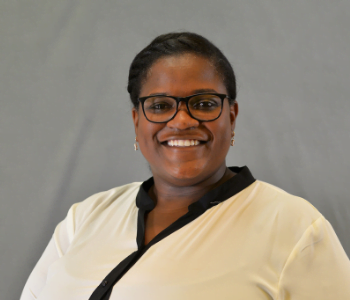 Dean, School of Arts and Sciences,
Associate Professor of Mathematics
Education
Ph.D. in Mathematics, University of Iowa
M.S. in Mathematics, University of Iowa
B.S. in Mathematics, Ohio State UniversityTeaching and Research Interests/Recent Publications or Scholarly Output
My teaching and research interests include abstract algebra, representation theory, and STEM education. -
Jamie Berrie
Interim Chair, Department of Mathematics and Data Science
Senior Lecturer of MathematicsEducation
E.d.D. in Curriculum and Instruction (Concentration in Higher Education Administration), Columbus State University (expected 2027)
M.S. in Applied Mathematics, Western Carolina University
B.S. in Mathematical Sciences, Armstrong Atlantic State UniversityTeaching and Research Interests / Recent Publications or Scholarly Output
My research interests include mathematics education and applied statistics, with a focus on using data-driven tools to improve student outcomes. I am particularly interested in how artificial intelligence can increase access to learning and reduce cost barriers in higher education. My applied work also spans agricultural statistics, exercise science, and fermentation science, where I use statistical modeling to study complex real-world systems. -
Dr. Lucy Bruce Horton
Part-time InstructorEducation
Ed.D. in Mathematics Curriculum and Instruction, Valdosta State University
Ed.S. in Teaching and Learning, Georgia Southern University
M.Ed. in Secondary Mathematics Education, Georgia Southern University
B.I.E. in Industrial and Systems Engineering, Georgia Institute of TechnologyTeaching and Research Interests / Recent Publications or Scholarly Output
My research interests include the lack of diversity in Advanced Placement courses and how AI affects work ethic and knowledge acquisition for students. My main focus is applied mathematics, more specifically, Calculus, and how to motivate and engage students in the classroom. -
Kyle Edwards
Part-time Instructor of Data Science
Education
M.S. in Information Technology Management, Tulane University
M.B.A. in Management, Campbellsville University
B.A. in Management, Lindsey Wilson University
A.A. in History, Lindsey Wilson UniversityTeaching and Research Interests / Recent Publications or Scholarly Output
My teaching and research interests are centered in a desire for continued education. I feel it is important to always be working on learning something new and enriching one’s knowledge. To continue my intellectual growth, I attend many webinars on topics of interest to my career and interests. -
Grover Harrell
Temporary Lecturer of MathematicsEducation
M.S. in Pure Mathematics, Georgia Southern University
B.S. in Mathematics, College of Coastal GeorgiaTeaching and Research Interests / Recent Publications or Scholarly Output
My research interests include Coxeter systems, Hecke algebras, and the combinatorial properties of Kazhdan-Lusztig polynomials. -
Annabelle Lassiter
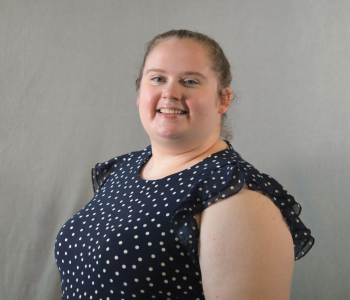 Lecturer of Mathematics
Education
Master of Statistics in Statistics, University of Florida
B.A. in Secondary Mathematics Education, Flagler College
B.S. in Mathematics, Flagler CollegeTeaching and Research Interests / Recent Publications or Scholarly Output
My teaching interests include mathematics and statistics, with a focus on developing students’ analytical and problem-solving skills. My research interests include psychometrics, assessment design, and item response theory, as well as applications of statistical modeling in education. I enjoy creating learning experiences that connect theoretical concepts to real-world contexts. -
Ashley Prosser
Lecturer of MathematicsEducation
M.S. in Mathematics, University of North Carolina Wilmington
Post-Baccalaureate Certificate in Statistics, University of North Carolina WilmingtonTeaching and Research Interests / Recent Publications or Scholarly Output
My teaching interests focus on helping students build a strong foundation in mathematics while encouraging critical thinking and problem-solving. I enjoy creating an engaging classroom environment where students can connect abstract concepts to practical applications. My research interests include mathematics education and algebra. I have studied the impact of Common Core standards on state testing and conducted a project on the zeros of polynomials. -
Dr. German Vargas
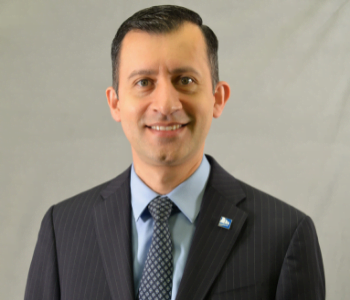 Provost and Vice President for Academic Affairs
Education
Ph.D. in Applied Mathematics, Wichita State University
M.S. in Mathematics, Wichita State University
B.S. in Physics, Universidad Nacional de ColombiaTeaching and Research Interests / Recent Publications or Scholarly Output
Computational fluid dynamics, mathematical modeling, partial differential equations, numerical analysis, and scientific computing. Notable project: Neural Bypass through a Brain-Computer Interface (BCI) that integrated an Electroencephalograph (EEG) with a Transcutaneous Electrical Nerve Stimulation (TENS) unit. In this project the user was able to move their arms without engaging the motor cortex and bypassing brain-spine communications. -
Dr. Aaron Yeager
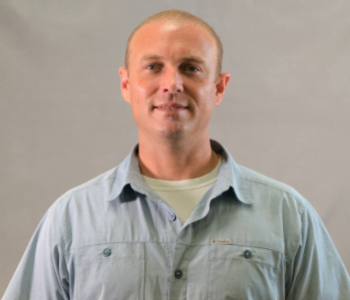 Associate Professor of Mathematics
Education
Ph.D. in Pure Mathematics, Oklahoma State University, Stillwater, OK
M.S. in Applied Mathematics, University of Missouri, Columbia, MO
M.A. in Pure Mathematics, University of Missouri, Columbia, MO
B.S. in Mathematics, Missouri State University, Springfield, MO
A.S. in Mathematics, Los Angeles City College, Los Angeles, CATeaching and Research Interests / Recent Publications or Scholarly Output
Dr. Yeager’s teaching philosophy centers on building strong relationships with students, fostering confidence with course material, thoughtfully integrating technology, and creating an active, supportive learning environment. Through mentoring from experienced colleagues and participation in teaching conferences and seminars, Dr. Yeager believes that every course – and every group of students – requires a tailored approach. He prioritizes getting to know students early through office-hour visits and by sharing personal and mathematical stories that promote resilience and a growth mindset. He also integrates technology through tools such as Smart Boards, computer algebra systems, and visualization software to deepen conceptual understanding. Dr. Yeager continues to explore new ways to enhance learning through emerging technologies. Beyond the classroom, his commitment to outreach and mentoring – particularly for underserved students – has shaped his approach to teaching, reinforcing his belief that meaningful support, inclusive practices, and intentional engagement are essential to student success.Dr. Yeager’s research interests are Random Polynomials,
Orthogonal Polynomials, Asymptotic Analysis, Analytic and Algebraic Number Theory, Probability Theory, Potential Theory, Graph Theory, Harmonic Analysis, Complex Analysis, and Mathematics Education.
Publications:
1. with C. Corely and A. Ledoan, “The complex level crossings of random orthogonal polynomials.” accepted and to appear in Functiones et Approximatio Commentarii Mathematici.
2. with M. Landi, K. Johnson, G. Moseley, “Zeros of complex random polynomials spanned by Bergman polynomials,” Involve: A Journal of Mathematics (2021), Vol. 14, no. 2, 271–281.
3. “The variance of the number of zeros for complex random orthogonal polynomials spanned by OPUC,” Computational Methods and Function Theory (2020), Volume 20, no.~2, 255–277.
4. “Real zeros of random sums with i.i.d.~coefficients,” Colloquium Mathematicum (2020), Volume 161, 173–188.
5. with M.~Yattselev, “Zeros of real random polynomials spanned by OPUC,” Indiana University Mathematics Journal (2019), Volume 68, no.~3, 835–856.
6. “Zeros of random orthogonal polynomials with complex Gaussian coefficients,” Rocky Mountain Journal of Mathematics (2018) 48 no~.7, 2385–2403.
7. with I.~Pritsker, “Zeros of polynomials with random coefficients,” Journal of Approximation Theory (2015), Volume 189, 88–100.
8. with M. Rivera, M. Tomova, and C.Wyels,“The radio number of $C_n\square C_n$,” Ars Combinatorics (2015), Volume CXX, 7–21.
9. with R. Baker, W. Banks, and Z. Guo, “Piatetski-Shapiro primes from almost primes,” Monatshefte f\”{u}r Mathematik (2014), Volume 174, no.~3, 357–370.
10. with A. G\”ulo\u glu and W. Banks,“Carmichael meets Chebotarev,” Canadian Mathematical Bulletin (2013), Volume 56, no.~4, 695–708.
11. with W. Banks, “Carmichael numbers composed of primes from a Beatty sequence,” Colloquium Mathematicum (2011), Volume 125, no.~1, 129–137.
12. with T. Gassert, “Characterization of the vertex-reinforced random walk and trapping subgraphs,” The Pentagon (2008), Volume 68, no.~1, 21–28.
-
Dr. Renren Zhao
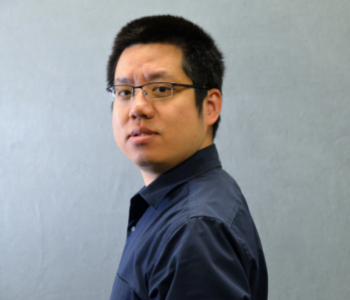 Associate Professor of Mathematics
Education
Ph.D. in Mathematics with Statistics emphasis, University of Missouri Rolla
M.A. in Applied Mathematics, University of Missouri Rolla
B.A. in Economics, Chongqing UniversityTeaching and Research Interests / Recent Publications or Scholarly Output
My teaching centers on statistics, probability, and computing/data science, with an emphasis on using computation and simulation to connect theory to real applications. My research interests include saddlepoint approximation and statistical inference, particularly equivalence testing in exponential families, with related interests in actuarial science, machine learning, and mathematics education.Recent scholarly output: Renren Zhao and Paige Robert, “Optimal Equivalence Testing in Exponential Families,” Statistical Papers.