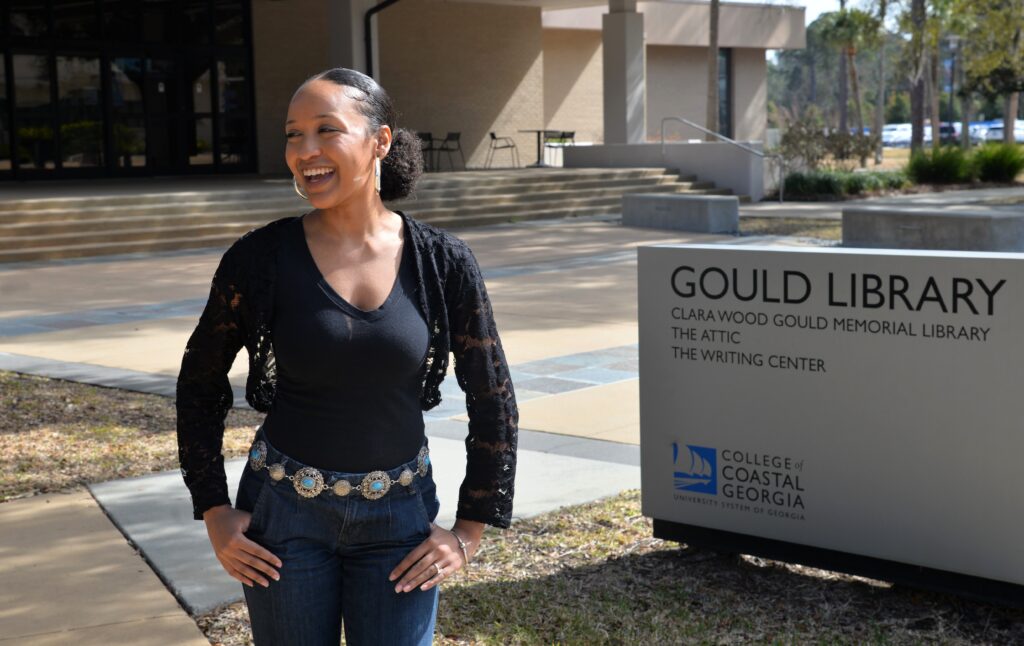
“Finding Confidence, Community, and Her Place at Coastal Georgia”
College of Coastal Georgia sophomore Dejah Murphy traded the noise and fast-paced life of San Jose, California, for the quieter, easier pace of Brunswick, Georgia. Not only did she find the peace of the Golden Isles, but she also found her voice—growing into a more confident young woman on the cusp of deeper self‑discovery.
Murphy is originally from California. Her grandparents, who now call Brunswick home, invited her to move to the area for a change.
“I wanted a completely different kind of environment. I’m a calm‑natured person. I like stillness,” she said. “I never heard of this place until my grandparents. They are from Chicago and said it’s very chill here, and that they go to the beach all the time. That’s why I moved here.”
Murphy is majoring in American studies, with a concentration in communication, literature, arts and media studies. She aspires to be a professor, but is also considering teaching with a nonprofit community organization for youth. In high school, she participated in Ujima, an organization that serves African American youth by increasing academic success and building community. Inspired by her mentors, she hopes to do the same for others. Ujima was vital to her development, especially since she and her classmates did not receive much encouragement to pursue college.
“I didn’t have that support system of going to different colleges to tour and learn the process. At the school where I came from, my teacher told me I was never going to college,” Murphy said. “There were some good teachers there, but I always felt like the school didn’t value the students that went there.”
Students at her school were not encouraged to take the SAT.
“He (the teacher) said, ‘There’s no point in you guys taking the SAT because you’re not going to college anyway. If you want to take it, go ahead, but don’t feel like you have to.’ So most of the students in the class didn’t take it, but another girl and I wanted to take it and go to college,” Murphy said. “I went to the principal. The principal didn’t do anything and looked at us like, ‘Well, it’s kind of true.’ When you have that experience with adults, you feel like you can’t do anything, and that’s sad. That was the main reason why I want to teach—for those students who were told their whole lives that they can’t get good opportunities and they’re not smart enough. It gives me motivation. That’s why I’m here.”
Murphy came to Coastal without knowing much about the institution, other than her grandparents praising it as a good school.
“I moved here without knowing how the campus looked. I went based on, ‘I want to go to college. I want to prove them wrong,’” she said.
She described herself as an average student in high school, and the idea of attending a large institution intimidated her. She found Coastal Georgia to be exactly what she needed.
“I’ve always felt inadequate as a child, so going to a big fancy school was crazy. I didn’t know if I would stand out, if people would notice me, or would think I wasn’t smart enough. Here, I felt more comfortable because it’s smaller,” she said. “When I actually got into my classes and started talking to my professors, it was like, ‘Oh, this isn’t as scary as I thought.’”
When she first enrolled, Murphy was a business major. After struggling academically, she took a year off but continued to feel pulled back to college.
“When I originally decided to not come back, I said, ‘Yeah, college is not for me.’ However, I just felt this urge to do assignments out of nowhere,” she said, laughing. “I would just go on YouTube and binge‑watch a whole topic. I said, ‘You just need to go back to school and major in something you like.’ So, I gave it another shot and did well.”
Her second attempt proved far more successful, especially once she began connecting with professors like Dr. Lainie Pomerleau, assistant professor of English, who encouraged her and affirmed her abilities.
“When you have professors like Dr. Pomerleau, who are intelligent, telling you that you’re also intelligent as well, I think that really changes the college experience for people that come from low‑income neighborhoods,” Murphy said. “That’s what I appreciate about Coastal. I like that it’s small and you have the opportunity to get to know professors.”
A Safe Space
Murphy has two jobs—one at Surcheros on St. Simons Island, and another as a student worker at the Clara Wood Gould Memorial Library. It’s the second job that she considers her favorite and her safe space. She grew up loving libraries. Her grandmother, a devoted book lover, would take her to the library every day when she was a child.
“She’s a believer in not buying books. She would say, ‘There’s no need to buy books. I’m going to the library and utilize my resources.’ So, I’ve always been a huge lover of libraries and how you can get books for free, and it’s for everybody. I also like that the library is a place for you to literally exist. It’s very much for the community. Anybody can go there and get resources. I love being able to work in that environment,” she said.
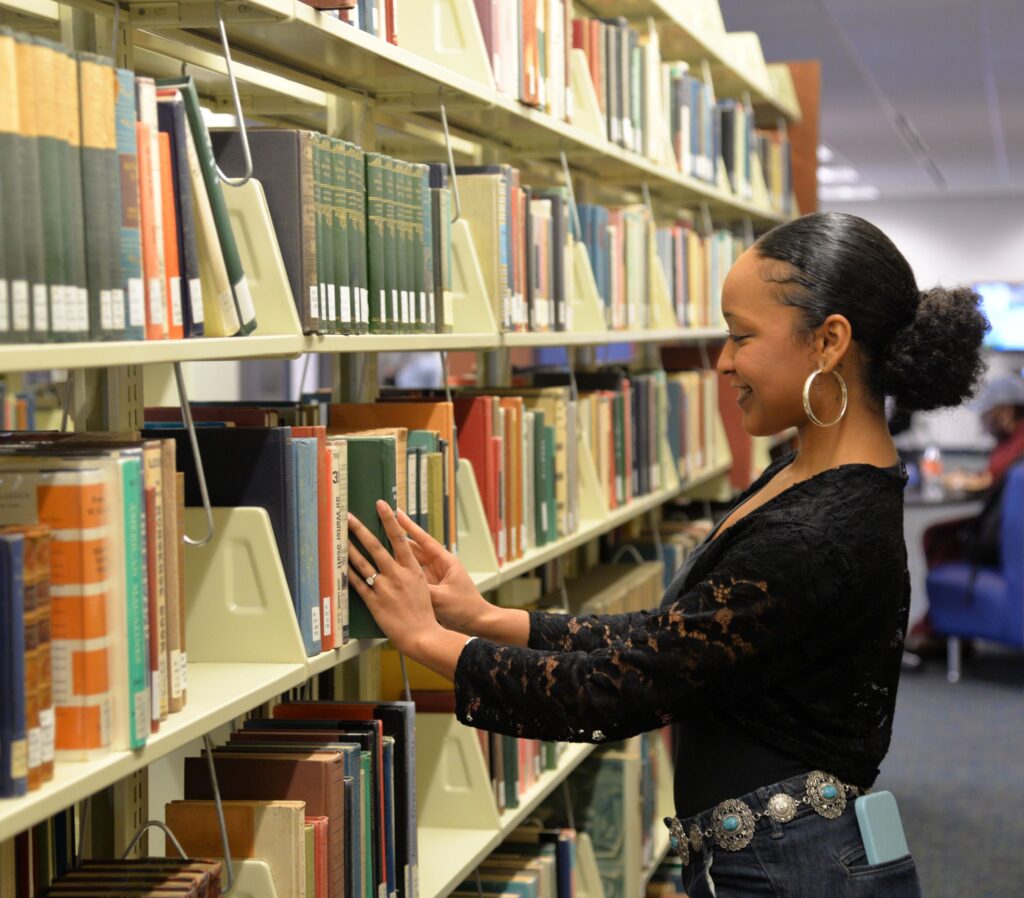
Her duties at the library include checking out books, reserving rooms, shelving books (her favorite task), helping people on the computer, and completing other assignments from the librarians. Her love for the library came in handy when she presented her research project there, giving her a space where she already felt comfortable.
Murphy’s research explored French philosopher Michel Foucault’s framework of utilitarianism and the panopticon, and their ties to modern society. Utilitarianism is the belief that an action is right if it promotes happiness, and wrong if it promotes unhappiness or pain. The panopticon is a circular prison design with cells around a central tower from which prisoners could be observed at all times. Its power lies in the belief that one might be watched, prompting prisoners to self-regulate. Murphy’s research examines how these ideas operate today, creating a “social panopticon,” where people surveil one another and act as guards.
“I thought it was fascinating how we surveil each other—for example, cancel culture. We use utilitarianism as punishment, that if you do this thing, we’re going to punish you publicly for the greater good. I thought it would be cool to explore that, and how it’s in our media as well,” Murphy said. “We kind of govern ourselves because we might be recorded. You may not say something in public with your friend because you could be recorded and canceled. Sometimes, it’s valid because some people are bad. During my research, I couldn’t decide if it was good or bad. It’s hard when you look at it from different sides. Maybe it’s good, but maybe it’s bad because it’s invasive and we shouldn’t monitor people. There are so many gray areas.”
Murphy was excited to present her work, and that enthusiasm helped ease her nerves. While she usually doesn’t feel excitement before a presentation, this time was different.
“I think the fact that it was in the library helped as well. I felt comfortable being there. That’s definitely my safe space,” she said. “I think my confidence changed in terms of my speech and feeling intelligent. For the longest time, that’s what made me scared to talk in front of people. I didn’t feel smart enough to be here. I had imposter syndrome. I think by that time, especially after Dr. Pomerleau’s class, I started to value my worth in these spaces.”
Pomerleau commended Murphy’s work and describes her as an exceptional student. She considers herself, the American studies program, and the College fortunate to work with Murphy.
“She embodies the goals and mission of Coastal Georgia, and her work on utilitarianism and its relationship to policy and industry has the potential to change lives,” Pomerleau said. “She is a compassionate class and community member who is eager to help other students and those around her. She happily assumes leadership roles in the classroom and beyond. Dejah plans to pursue graduate study at the Ph.D. level, and I’m excited to follow her as she builds what is sure to be a fascinating and impactful career.”
Although Murphy wanted to attend college to prove her former educators wrong, she never imagined she would one day stand before an audience and present her own research. She is learning to value her own voice and presence—believing that what she says matters.
Finding Her Voice
In past years, Murphy often felt overlooked by her peers and adults. Back in California, the student body at her school was predominantly Mexican and Asian. Being half Black and half Mexican, she didn’t feel accepted, and felt that her presence was undervalued. She was also timid, and her learning disability—ADHD—added another layer of misunderstanding from teachers and classmates who viewed her as unintelligent.
“It was a lot growing up, but now I have ADHD and I do not care. It has nothing to do with intelligence,” she said. “That’s another thing I love about Coastal. No one has ever made me feel that I wasn’t smart enough, or made me feel bad that I have a disability when I’m getting my accommodations.”
Despite wanting to attend college, she questioned whether she could keep up academically.
“I think for so long I just felt like I was constantly overlooked. So now, as an adult, I’ve got some stuff to say and it should be known,” she said, smiling. “I should put myself out there. I should say yes to opportunities even though I may be scared, because I have a voice and I can help people. I’m learning, especially with the College being tight-knit, that there are people who are open, who value my existence, and that I can receive friendship, love, and talk to people.”
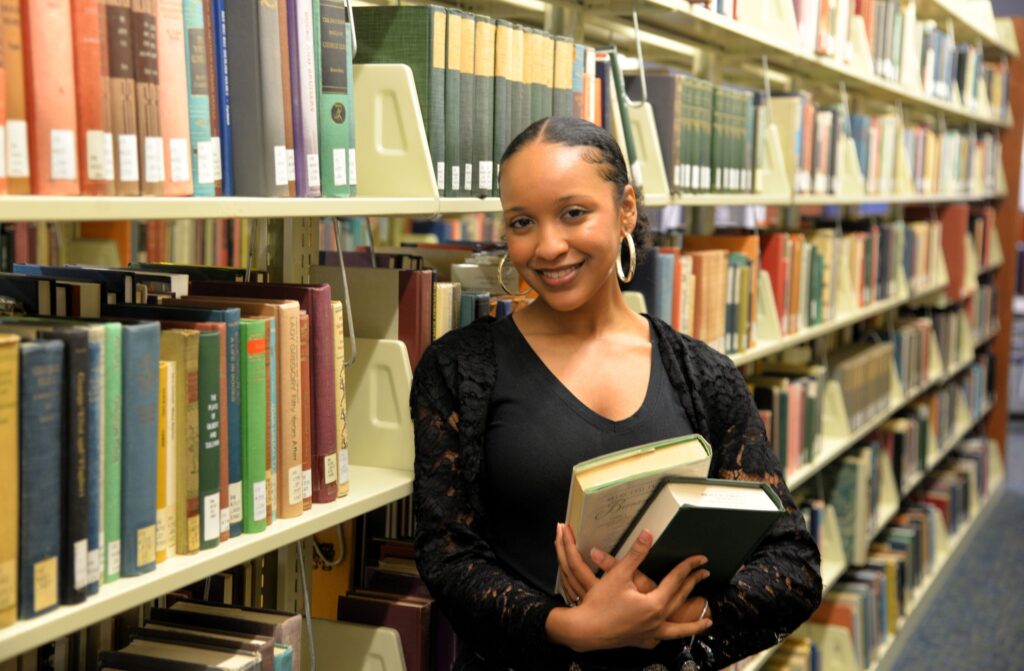
If encouragement from her professors and the success of her research presentation weren’t proof enough, Murphy was also recognized on the President’s List for the Fall 2025 semester. Students are named to the President’s List if they earn 12 or more credit hours (or six in the summer) in courses at the 1000 level or above and achieve a term grade-point average of 4.0.
“That showed me that I am capable and that my existence here is well-deserved and well-received by other people,” she said.
Being named to the President’s List is one of Murphy’s favorite college memories so far.
Murphy knows she made the right choice moving to Brunswick. She loves the sense of community and how people are eager to start conversations.
“I never experienced that feeling of community. Moving here, I learned that you can trust people,” she said.
Finding Balance
Murphy’s advice to her fellow students is simple: talk to your professors, whether or not you’re struggling.
“Talk to them,” she said. “Professors are cool. Teachers in general are cool people, and they’re very patient. Also, utilize your resources like the ATTIC (Academic Tutoring and Instruction Center) and the library.”
She believes students should enjoy hobbies and interests outside of school. Although she loves to read, she once felt she shouldn’t take time for it, thinking it would take away from studying.
“My brain was going crazy because I wasn’t pouring into myself. I think it’s important to still do the things you love, because it will make you better as a student when you have balance,” Murphy said.
In her spare time, she enjoys reading, drawing, analyzing music, and collecting old magazines. She fondly recalled owning a 1970s edition of Evergreen Magazine and seeing what life was like decades ago. She hopes to return to writing soon, and is also into fashion, often using music or movie characters as inspiration for her outfits.
Today, as Murphy strides across campus with growing confidence, she embodies the truth that no one else gets to define her potential. She is not only proving her doubters wrong—she is thriving, discovering her voice, and proving to herself that she belongs in every room she enters. Her journey is a reminder that the limits others place on us often reveal more about their imagination than our abilities.