
Learning about Strategic Communication for Justice and Social Change
The campus community at the College of Coastal Georgia learned about the importance of strategic communication in the pursuit of justice and social change during a recent Afternoons with Arts & Humanities presentation hosted by the Department of Arts and Humanities. The featured guests were justice advocates Gerald Griggs, a civil rights attorney, and Dontaye Carter, a journalist and CEO and founder of Carter Media Group.
Carter and Griggs were both involved in the Ahmaud Arbery case, working to seek justice for Arbery and his family. Griggs served as the special investigator for the NAACP, and Carter, who has covered several high-profile cases, helped manage communications and media outreach surrounding the case. They presented “The Ahmaud Arbery Case: Strategic Communication, Reconciliation, and Policy Change on the Path to Social Justice,” discussing how they became involved in the case and the steps taken toward justice and reconciliation.
Importance of the Case
On Feb. 23, 2020, 25-year-old Ahmaud Arbery was fatally shot while jogging in the Satilla Shores neighborhood near Brunswick, Georgia. Three white men — Travis McMichael, Gregory McMichael and William “Roddie” Bryan — pursued Arbery in pickup trucks, claiming they suspected him of burglary. The men used their vehicles to block his path, and during a confrontation, Travis McMichael shot Arbery. Bryan recorded the incident on his cellphone, and the video later became critical evidence. All three men were convicted of multiple felonies, including attempted kidnapping and federal hate crimes, after prosecutors argued they targeted Arbery because he was Black.
Griggs said footage of Arbery’s murder “summoned the best parts of Georgia out of one of the worst things to happen in Georgia in 100 years.”
“The social justice movement, in its current iteration, was born in Satilla Shores in Brunswick, Georgia, because of this case,” Griggs said. “The case is important because Georgians of good conscience decided enough was enough, and we decided to investigate.”
In their pursuit of justice, Griggs and Carter shared how they used Dr. Martin Luther King Jr.’s six steps of nonviolent social change: information gathering, education, personal commitment, negotiation, direct action, and reconciliation.
For the first step — information gathering — Griggs went door to door in Satilla Shores, speaking with neighbors about what happened and how they felt.
“The same thing was echoed by all of those neighbors: This is not reflective of our community and something is wrong here,” he said. “The reason the case matters so much is because this was Georgia’s opportunity to show the rest of the world that even in the Deep South, people of good conscience can come together and solve an atrocity.”
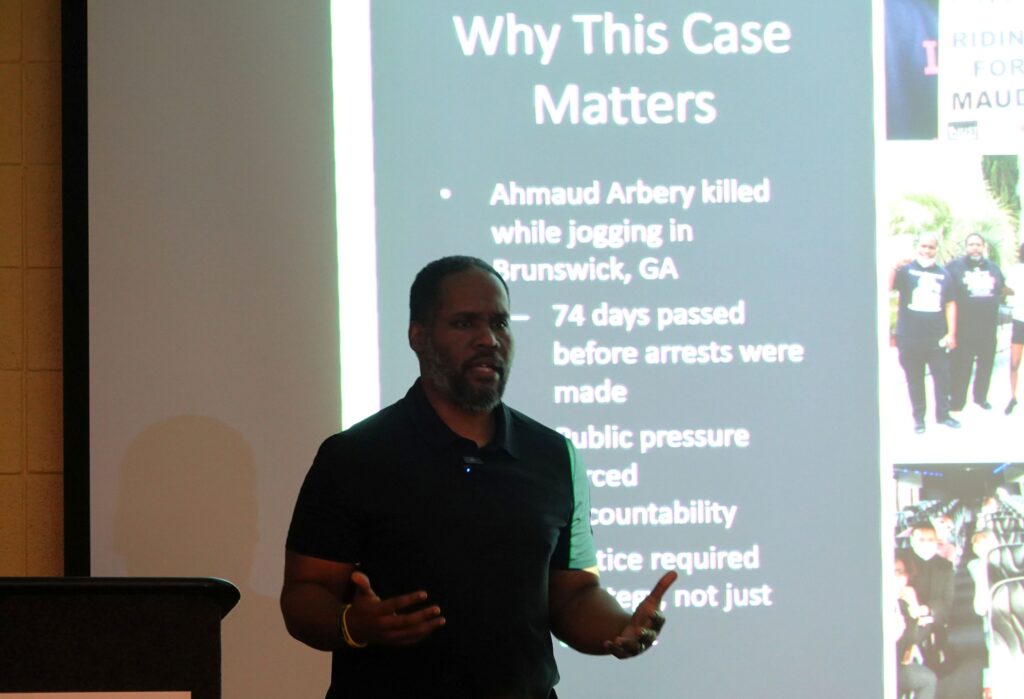
Civil Rights Attorney Gerald Griggs talks about the unity of the Brunswick community in the pursuit of justice for Ahmaud Arbery.
The second step, educating the public, involved breaking through “echo chambers” of misinformation, Griggs said, and working with media outlets to ensure the facts were known. For personal commitment, individuals outside Arbery’s family showed up in solidarity and support, driven by a personal interest in seeing justice achieved.
Negotiation, the fourth step, included maintaining pressure on the Justice Department to fully investigate and prosecute the case at the federal level. Direct action — the fifth step — occurred through national and international protests, rallies, and packed courtrooms throughout the trial process. Griggs said the most important step, reconciliation, cannot happen without justice.
“Trauma exists in the absence of justice, but you also have to come back and appreciate that it took the entire state of Georgia — 11 million citizens who were all outraged about what happened. We sent a message to the rest of the world,” Griggs said. “Those six steps Dr. King so eloquently talked about, we put into action to make sure that what happened about 12 miles from here will never ever happen again in the state of Georgia. If it does, we’re going to send a message just like we did in this case.”
Reconciliation not only included the convictions of those responsible but also changes to laws and policies.
The Atlanta City Council also issued a proclamation celebrating Arbery’s life and declared May 8 as Ahmaud Arbery Day in Atlanta.
The Power of Narrative
Carter quoted English philosopher and social reformer Jeremy Bentham, who said, “Publicity is the very soul of justice.” Carter discussed the ability to reshape the narrative through storytelling, educating the public, and coordinating with the media.
“We can start to tell these stories through the eyes of Ahmaud’s parents, through the eyes of his auntie, through the eyes of the community,” Carter said. “The more that we elevated those voices, we understood that narrative was going to influence policy.”
Keeping the public informed not only combated misinformation but also created buy-in from the community. Carter attributed the sustained pressure around the case to engagement not only from the Brunswick community but also from communities throughout the state. Social media influencers also became involved, participating in marches and rallies. Carter said he read through social media comments to find valid questions they could answer to further educate the public. Videographers were brought in as well to document and capture the stories of Arbery’s family.
“It was about humanizing him, allowing people to see him for more than just the narratives and the stereotypes that are attached to the color of his skin,” Carter said. “It’s reminding folks that he’s somebody’s son, somebody’s nephew, and that we’re talking about people’s lives.”
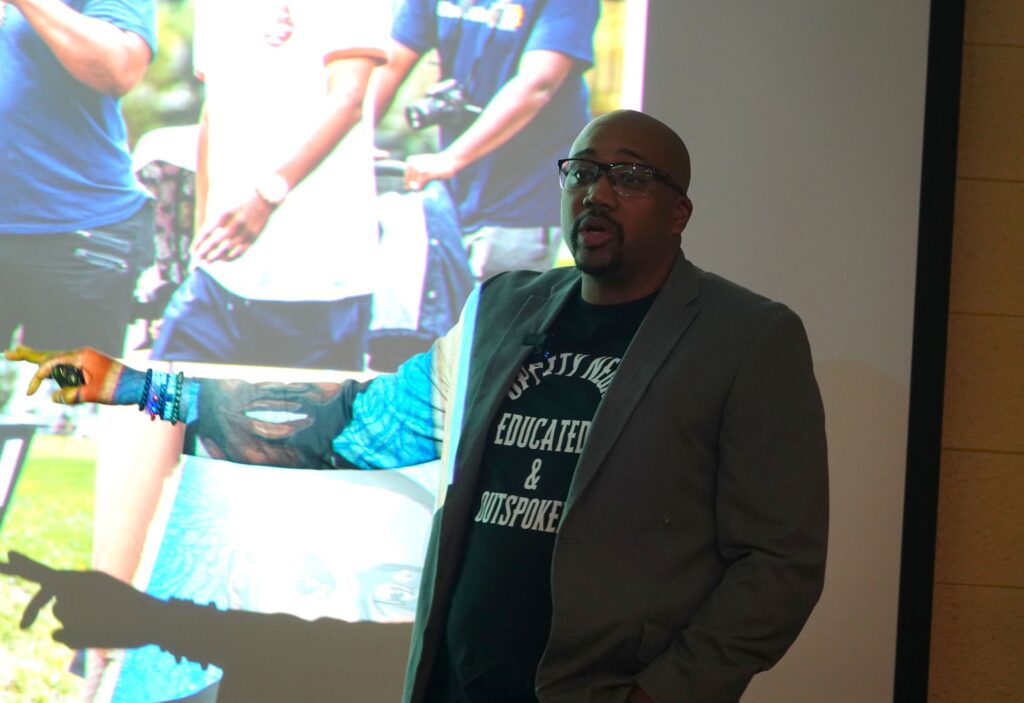
Dontaye Carter, journalist, CEO and founder of Carter Media Group, explains how how narrative can influence perception and policy.
During this time, constant counternarratives were emerging from various commentators and media outlets. Carter said it was important to work with national and local media and with videographers to provide consistent, truthful information. Griggs said it was also essential to focus on the individuals responsible, noting that some tried to criminalize Arbery instead.
“They wanted to talk about why he was in the neighborhood and what was happening, but not focus on these three individuals,” Griggs said. “I wanted to make sure that the truth was coming out. Then to watch the media try to criminalize some of the previous interactions that Ahmaud had with law enforcement — because he had some previous issues as far as mental health is concerned — that’s not relevant to whether these three individuals took his life in a non-justifiable manner. We had to refocus and reshape the conversation in such a way that we focused on what happened on that day, whether it was lawful and who did it.”
Carter recited the beginning of the preamble of the U.S. Constitution, explaining that one of the government’s earliest stated responsibilities is to promote justice. He said justice isn’t just an image of a courthouse but also involves changing laws.
“When you have a system that was built and influenced by prejudices, you have to address these things head-on,” Carter said. “This was a statewide effort. We had to paint the picture of what was happening here in Brunswick because if you don’t, the narrative is lost. Everything moves too fast with the internet and social media, so you have to be intentional.”
The path to social justice didn’t stop after the convictions of the McMichaels and Bryan. Griggs and Carter continued working to repeal Georgia’s 1863 citizen’s arrest statute and to help pass the state’s first hate crimes legislation.
“This is the birthplace of civil rights. This is the birth state of Martin Luther King Jr., and Georgia didn’t have a hate crimes act until 2020. So, I think it was important for us to recognize the importance of Ahmaud and the importance of the unity of the state,” Griggs said. “It takes a lot to unify a state. Georgia is a beautiful state. It’s so diverse and so welcoming, but it also has a history that we have to address as Georgians. The thing that gives me pride about being from Georgia is that we showed what Georgia is all about when Georgians come together.”
Griggs encouraged students to apply what they are learning to create change and to recognize that they are living history.
“Look at what legacy you’re going to leave your family,” he said. “You all made history. You all made an important chapter in the story of Georgia.”
Carter emphasized that people today have the greatest opportunity yet to tell their own stories.
“We have an ability, in this moment, to tell our stories with detail and context more than those before us. We have an ability to control the narrative. We don’t have to wait for the media to show up anymore. We can pull out our phones and livestream. We have so much — from a technological standpoint — that we can leverage to ensure that we truly are lifting up our voices,” Carter said. “What happened in 2020 doesn’t have to stop. We just have to learn how to continue to tell our story with the detail and the context that’s necessary.”
In the Arbery case, and in every case he has tried, Griggs said there was a controversy, facts and then a decision. All that is needed, he said, is to put those three elements together and not be afraid to speak the truth.
“The moral arc of the universe is long, but we bend it toward justice. Justice is not self-executed. It requires strategy, discipline, people willing to act, and reconciliation must be found — it must be the foundation of lasting change,” Griggs said.
Griggs and Carter said they have renewed hope for the state and look forward to continuing to educate and inspire the next generation on how to achieve justice after a tragedy.
After their talk, Griggs and Carter showed a video highlighting their efforts for social change in the Arbery case and took questions from the audience. They answered questions about perception, how to keep young people invested, and the process of information gathering.
“The Ahmaud Arbery Case: Strategic Communication, Reconciliation, and Policy Change on the Path to Social Justice” is also a featured chapter, co-authored by Griggs and Carter in the book Reconciliation: The Final Step in Achieving Nonviolent Social Change.
To watch Carter’s video shown during the presentation, click here.