
Environmental Students Share Research at Prestigious National Conference
Students in the College of Coastal Georgia’s environmental science program presented their research at one of the world’s largest gatherings of earth and space scientists—the 2025 American Geophysical Union (AGU) Fall Meeting—in December. Twenty-one students, alumni, and faculty presented their research alongside leading scientists, networked with professionals in their fields, and experienced the breadth of contemporary research in environmental science, geology, and related disciplines.
The annual meeting, held in New Orleans, attracts thousands of scientists, educators, and policymakers from around the globe to share cutting-edge discoveries, innovations, and provides a platform for collaboration and knowledge exchange. Coastal students presented their original research on topics including coastal resilience, geology, climate change, and marine life.
Dr. James Deemy, associate professor of environmental science, said attending AGU’s annual meeting is an amazing opportunity for students to engage with the scientific community.
“Our students are exemplary attendees of the meeting by participating in a wide variety of workshops, sessions, and professional development opportunities,” Deemy said. “They took full advantage of this opportunity to establish themselves within the AGU community, while gaining exposure to the vast array of potential geoscience career pathways.”
Dr. Kimberly Takagi, assistant professor of environmental science, said she was excited to see students’ enthusiasm about the trip and their eagerness to learn outside of the classroom.
“While we told them it was their chance to see how what they’ve learned in the classroom is applied to careers and professions, we had no idea how much they would genuinely be excited to participate, network, represent the College, attend presentations, ask questions, and talk to graduate school programs,” Takagi said. “At the end of the day, we were incredibly proud of our students. They not only represented themselves well and professionally presented and explained the work that they’ve done, they also represented the College well and took advantage of all the opportunities that they could.”
Takagi hopes that their experience at AGU will stay with them and positively influence the trajectory of their careers, no matter where they go.
Senior Morgan Phillips, of Grovetown, Georgia, presented “The Impact of Extreme Seasonal Temperatures on Suicide Rates.” Her experience demonstrated how much of an impact her work can have on others.
“Having professionals from across the globe take interest in and compliment my research was a surreal experience,” Phillips said. “It put into perspective just how much larger its impact is than I had ever realized.”
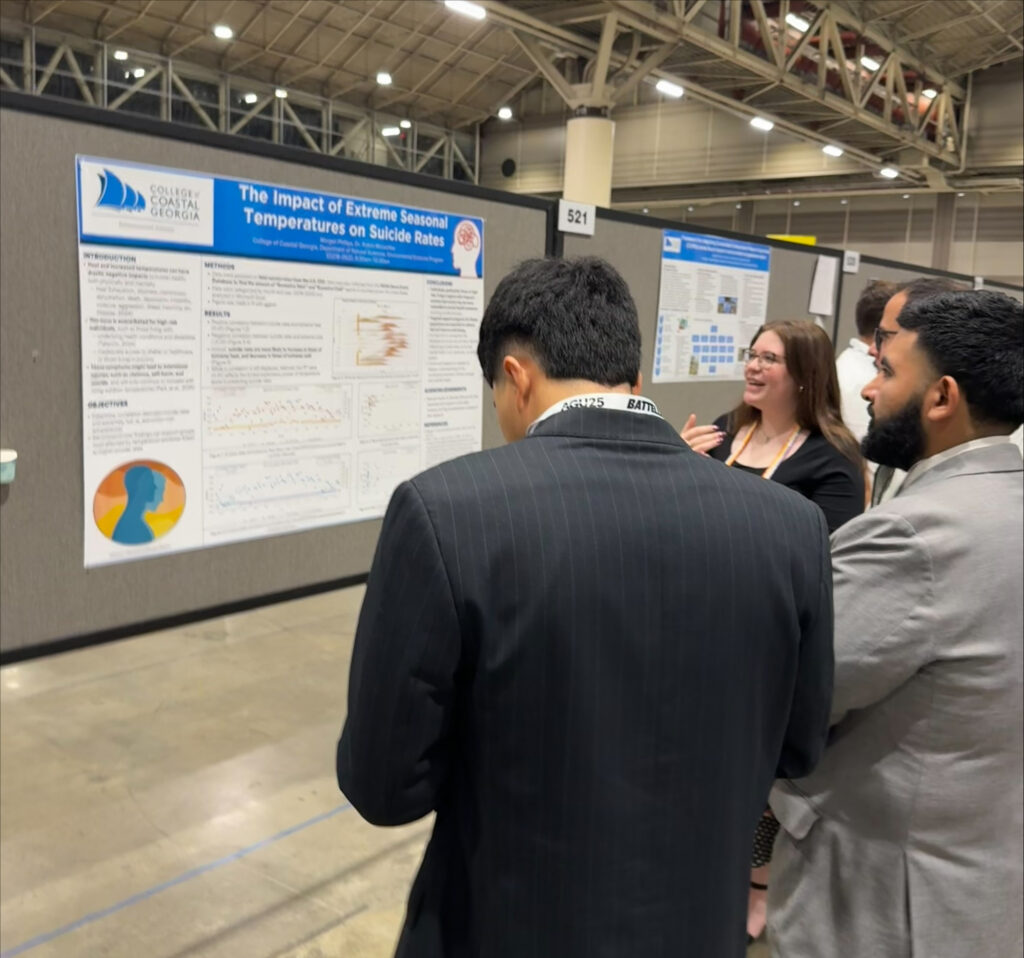
Morgan Phillips presents her research poster “The Impact of Extreme Seasonal Temperatures on Suicide Rates” at the 2025 AGU Fall Meeting.
Senior Nina Herter, of Brunswick, presented “Comparing the Influence of Shoreline Dynamics on Sediment Characteristics across Developed and Undeveloped Barrier Islands in South Georgia and North Florida.” She was amazed by the scope of the research being presented.
“AGU was an amazing experience that showed me that there is so much that the science community has to offer,” Herter said. “Between every oral presentation I attended, person I met, exhibitor I spoke with, and poster I saw, I was in complete awe of how many people are doing incredible work.”
Attending the conference in New Orleans also gave students an opportunity to see places that they had learned about in class, making those connections stronger and more personal. Dr. Robin McLachlan, assistant professor of geology, shared that New Orleans is often discussed as a case study in courses, including its eroding shoreline and the impacts of human-built dams and levees.
“Since these conversations occur in a classroom hundreds of miles away from the delta, they tend to be science forward with a matter-of-fact tone. During our trip, these conversations were grounded in lived realities. While at the conference, we visited The Lower Ninth Ward Living Museum at the TEP Center,” McLachlan said. “Students had the rare opportunity to meet Dr. Leona Tate, who was one the first young girls to desegregate schools in the Deep South. She shared her stories of growing up in New Orleans and trying to rebuild the community post-Hurricane Katrina. Students learned how geology and the environment are closely tied to human wellbeing, cultural movements, and politics.”
After the museum visit, students and faculty visited the location of the levee breach, adding more weight to their discussions of environmental engineering, McLachlan said.
For Coastal alum Maraya King, of Hoboken, Georgia, who is pursuing additional certifications, the trip to the museum and levees brought more of her research to life. King had three research projects at the conference, including one titled, “A Hybrid-Forward Selection Regression Model to Estimate the Atlantic Hurricane Risk for Eastern and Southern Coastal Counties of the United States Using Publicly Available Data.”
“Presenting my ongoing research on Atlantic hurricane risk estimation at AGU25 in New Orleans was deeply impactful, especially as I learned how the levee failures and the flooding that took place there during Hurricane Katrina were predicted a year earlier, but tragically ignored,” King said. “While touring the sinking levees, a graffiti image of a Sankofa bird reaching behind for its egg reminded me that our generation of scientists must not only learn from the past, but take action if we are to build a better future.”
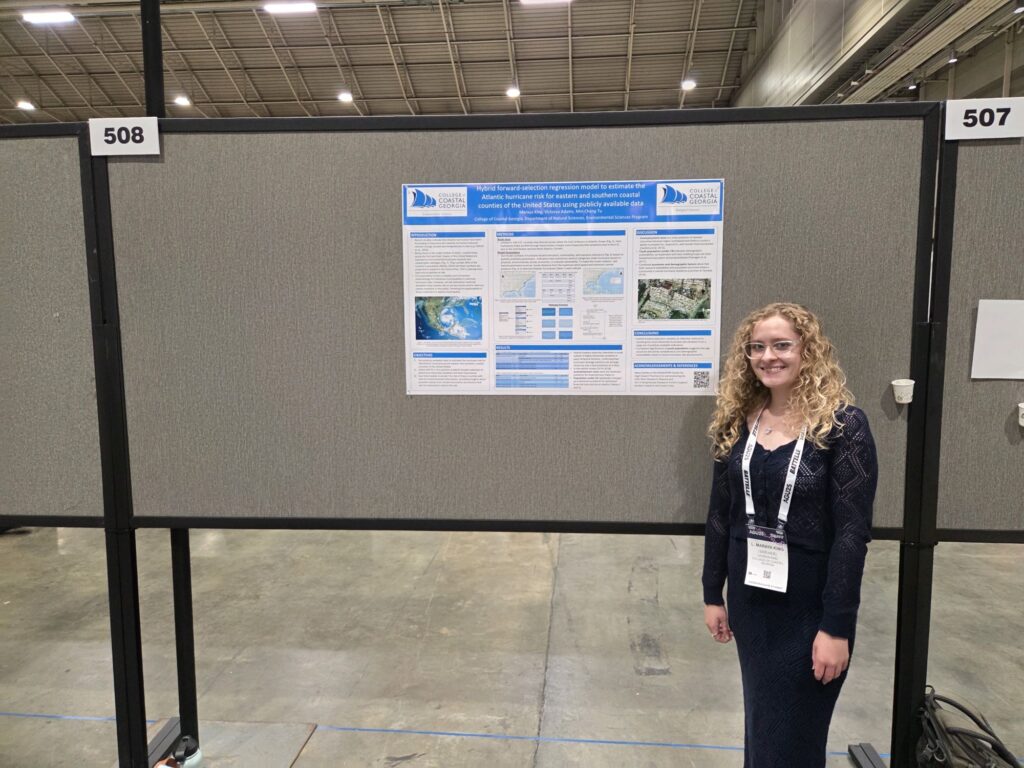
Coastal Georgia alum Maraya King stands ready to present her research project about hurricane risk.
Experiences like this humanize science and instill in students a responsibility to be stewards of both the land and its people, McLachlan said. It creates an impactful learning opportunity that motivates students to further their research, explore scientific career pathways, appreciate unique places, and understand the potential impact of their work on communities and regions. The College remains committed to providing experiential learning opportunities for students while advancing scientific understanding of environmental challenges.
The trip to AGU was made possible through undergraduate research funds awarded to students by the College and donations from generous supporters of the program.
The following is a list of student and alumni research presentations at the 2025 AGU Fall Meeting:
Hannah Harrison: “Assessing the Relationship Between Macroalgae and Phallusia nigra in Southeast Florida”
Damian Elmore: “Flood Impact Analysis of Downtown Brunswick Ga: An Upper Level CURE Product”
“Bridging Learning and Research: Self-Reflections and Best Practices from Students and Faculty in Earth Science Undergraduate Research Programs, Including Vertically Integrated Projects (VIPs) and Course-Based Undergraduate Research Experiences (CUREs) Poster”
“Framework for integrating Course-based Undergraduate Research Experiences (CUREs) across the curriculum in environmental and geoscience majors”
“Spatial Patterns in Submerged Aquatic Vegetation Distribution at Phil Foster Park, Florida, USA”
Reid Kroken: “Framework for integrating Course-based Undergraduate Research Experiences (CUREs) across the curriculum in environmental geoscience majors”
Téa Autry: “Framework for integrating Course-based Undergraduate Research Experiences (CUREs) across the curriculum in environmental geoscience majors”
Nina Herter: “Comparing the Influence of Shoreline Dynamics on Sediment Characteristics across Developed and Undeveloped Barrier Islands in South Georgia and North Florida”
Morgan Phillips: “The Impact of Extreme Seasonal Temperatures on Suicide Rates”
Sara Whittier: “Modeling Post-Fire Vegetation Recovery in the Okefenokee Wetlands Using Remote Sensing and Generalized Additive Mixed Models”
Marisa Field: “Empowering Undergraduate Research Through LoRaWAN-Enabled Sensor Networks: A Coastal Salt Marsh Case Study from the FS3 Critical Zone Summer Program”
Austin Martin: “Flood Impact Analysis of Downtown Brunswick Ga: An Upper Level CURE Product”
Emily Weber: “Plankton Diversity & Water Quality Patterns Across Reef Zones at Phil Foster Park Artificial Reef Trail”
Paige Spence: “Evaluating Inlet Breach Effects: Coastal Monitoring and Beach Profiling on Cabretta Island, GA”
Claire Hannah: “Ab initio Investigation of the Effect of Carbon Dioxide on Water Complexes of Atmospheric Acids”
Ollie Mercer: “Spatial Patterns in Submerged Aquatic Vegetation Distribution at Phil Foster Park, Florida, USA”
Emma Robison: “Spatial Patterns in Submerged Aquatic Vegetation Distribution at Phil Foster Park, Florida, USA”
“Applying Modern Biodiversity Indices to a Pleistocene Fossil Assemblage from Clark Quarry, Georgia, USA”
James Hutchinson: “Applying Modern Biodiversity Indices to Pleistocene Fossil Assemblage from Clark Quarry, Georgia, USA”
Joshua Kreider: “Ab initio Investigation of the Effect of Carbon Dioxide on Water Complexes of Atmospheric Acids”
Jae Clery: “Orca Migration Northward in Response to Climate Change”
“Ab initio Investigation of the Effect of Carbon Dioxide on Water Complexes of Atmospheric Acids”
Maraya King: “A Hybrid-Forward Selection Regression Model to Estimate the Atlantic Hurricane Risk for Eastern and Southern Coastal Counties of the United States Using Publicly Available Data”
“CURE (Course-based Undergraduate Research Experiences) for the common research methods course: small scale rapid research experiences on Sapelo Island”
“Tidal and Temporal Variations of Ammonia and Phosphate on Sapelo Island”
Megan Bagley: “Orca Migration Northward in Response to Climate Change Tidal and Temporal Variations of Ammonia and Phosphate on Sapelo Island”
“Tidal and Temporal Variations of Ammonia and Phosphate on Sapelo Island”
Samuel Hoover: “CURE (Course-based Undergraduate Research Experiences) for the common research methods course: small scale rapid research experiences on Sapelo Island”
“Impacts of Different Artificial Reef Structures on Species Diversity and Population Numbers”
Jaxson Grotz: “Tidal and Temporal Variations of Ammonia and Phosphate on Sapelo Island Earth Systems Science Course-based Undergraduate Research Experience through Independent Study Research: Estimating Fiddler Crab (Uca pugnax) burrow density and sediment turnover”
“Tidal and Temporal Variations of Ammonia and Phosphate on Sapelo Island”
Brandon Baker: “Impacts of Different Artificial Reef Structures on Species Diversity and Population Numbers”
Keira LePage: “Impacts of Different Artificial Reef Structures on Species Diversity and Population Numbers”
Claire LaPorte: “Site Analysis of Hunting Island, SC for Implementing Living Shorelines”
Thomas Payne: “Tidal and Temporal Variations of Ammonia and Phosphate on Sapelo Island”
Victorya Adams: “Hybrid-Forward Selection Regression Model to Estimate the Atlantic Hurricane Risk for Eastern and Southern Coastal Counties of the United States Using Publicly Available Data”
Christian Pscholka: “Reflection over field research on Sapelo Island as a student onto becoming a lab coordinator”