Geology

The concentration in Geology as part of the B.S. in Environmental Science degree is designed to provide geology knowledge as well as field and laboratory skills in preparation for a variety of geoscience careers. Advanced undergraduate training in geology is highly useful to environmental science professionals because it provides a background in the structure and function of the Earth, which is the ultimate baseline for all environmental science sub-disciplines. Students interested in pursuing careers in the energy sector, earth materials, economic minerals and industries, and environmental consulting fields are particularly encouraged to explore this concentration. Additionally, students hoping for careers in water resources or hydrogeology should pursue this concentration.


Why study Geology at Coastal Georgia?
The College of Coastal Georgia is situated in the Coastal Plain – one of the most dynamic landscapes in the world – giving us a unique opportunity to observe, explore, and research this ever-changing region. Georgia’s coast is lined with barrier islands that preserve evidence of ancient sea-level change, shoreline migration, and adaptive ecosystems over the past tens of thousands of years. If you want a window further back in time, the nearby Blue Ridge Mountains preserve evidence of their uplift and formation hundreds of millions of years ago. Georgia is also rich in natural resources. We lead the U.S. production of kaolin, and are a major producer of construction material and gemstones.
Our field-based courses provide students with hands-on, place-based experiences to explore everything from coastal dynamics, to mountain building and erosion, and natural resources and mining. Additionally, our working relationships with the Department of Natural Resources, the University of Georgia Marine Extension, and several regional mining companies further provide opportunities for students to get involved in geological research and resource management.
What will I learn?
Geology is not simply the study of rocks, but a wider exploration of the Earth’s history, chemistry, and physics, As part of the geology concentration, students establish a deep understanding of the physical composition of the Earth and the forces acting on it, focusing on the Earth’s natural resources – hydrology, geochemistry, and coastal geomorphology. Through courses and independent research, students ask and answer fundamental questions about the forces at play during our Earth’s formation and in its future. At every stage of study, Coastal aims to get students out in the field – whether observing how ocean-going research vessels work, or hiking through our state parks to witness geologic structures. Students work together to conduct course-based research that prepares them with the necessary skills to do field and basic laboratory research.
What can I do when I graduate?
Graduates are prepared to start graduate school in any earth-science field, or to enter directly into a wide range of career fields, including consulting, mining, teaching, and research – all of which have strong job prospects. Why is the projected growth in jobs for people with geologic skills so much higher than in other fields? Geology is involved in many things that people rely on every single day. Geologists predict natural hazards and are essential for securing contracts and certifying plans for environmental projects. They are also responsible for finding and extracting the resources we use to fuel cars, construct solar panels, and build technological devices like computers. Because of this high demand and important role, geoscience skills are highly valued, and the median pay for geoscientists is nearly $90,000 per year.

A Great Scientist in the Making
Coastal Georgia alumna Kayla Russo is currently pursuing her geochemistry doctorate at Cornell University. She is a recipient of the highly prestigious National Science Foundation Graduate Research Fellowship Program.
“I am so grateful for the Dual Enrollment program and my decision to come to Coastal. I’m very passionate about our school being the best school.”


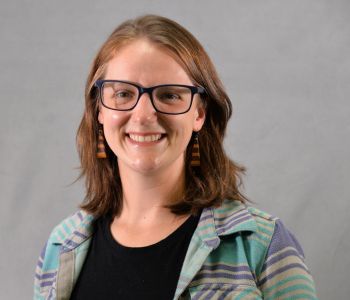
Dr. Robin McLachlan
Education
Ph.D. in Oceanography, Concentration in Marine Geology and Geophysics, University of Washington
M.S. in Oceanography, Concentration in Marine Geology and Geophysics, University of Washington
B.S. in Geology, College of Charleston
Teaching and Research Interests / Recent Publications or Scholarly Output
Robin McLachlan is a broadly-trained geologist interested in how the shapes of coastal environments are intimately linked to human development, and vice versa. Specifically, she studies sediment transport from source to sink, mountains to deep sea, focusing on the interaction between sediment and hydrodynamics in the fluvial-marine transition zone. She applies the same scientific rigor and inquiry to her role as an educator and communicator. Her teaching strategies constructively align scientific content with high-impact practices – notably undergraduate research and service-learning – to best achieve student learning goals and career success.
Recent fellowships include the Institute for Georgia Environmental Leadership (2023) and Governor’s Teaching Fellows (2025).
Recent publications include “Actionable Science for Small Island Communities: Wind Velocity and Sea‐Level Rise Enhance Tidal Flooding on Little Cumberland Island, Georgia”, published in AGU Community Science (Bertram et al., 2025).