Enterprise Risk Management
What is ERM?
Enterprise Risk Management is a “continuous business process, led by senior leadership, that extends the concepts of risk management, and includes identifying, assessing, mitigating, and monitoring risks to the organization.”
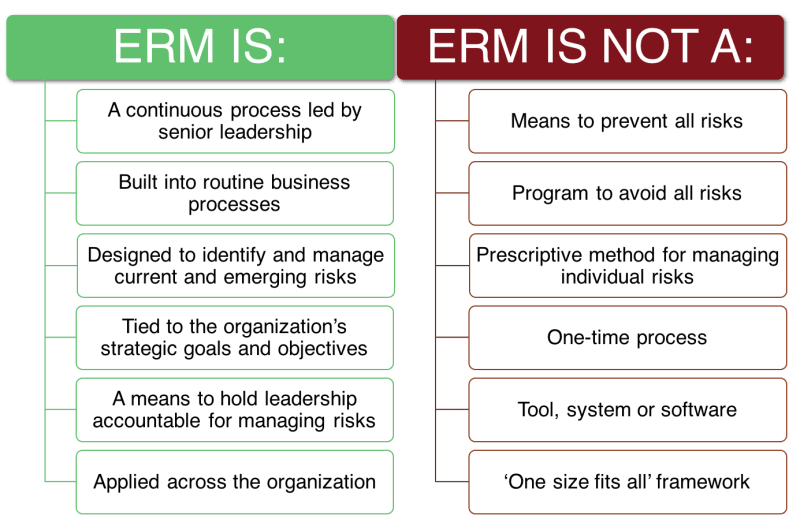
The image to the right (Stanford University, Office of the Chief Risk Officer, November 2017) provides a helpful visual overview of what ERM is and what ERM is not.
ERM Categories
- Strategic – Affects achievement of strategic goals and objectives
- Compliance – Affects compliance with federal, state, and local laws, rules, and regulations
- Reputational – Affects public perception and reputation
- Financial – Affects assets, technology, financial reporting and auditing
- Operational – Affects ongoing management processes and procedures
ERM Benefits
- Allows for the prioritization of response and action to identified high-level risks as part of an institution-wide mitigation action plan
- Enables senior leadership and others to continually improve ways to manage current and emerging institutional risks
- Ensures the seamless integration of strategic planning
ERM Policy
In accordance with BOR Policy 7.11 Risk Management Policy, each USG institution is required to do the following:
- Adopt an institution-wide approach to risk management
- Each president shall designate an ERM coordinator to assist campus administrators in maintaining the ERM framework
- Risk management processes will be embedded into the institution’s management systems and processes
- All risk management efforts will be focused on supporting the institution’s objectives
ERM Charter
Ethics and Compliance Training
The College ensures that all employees complete required training for policy, ethics, safety, loss prevention, and information security both at the time of hire and through refresher courses offered thereafter.
Compliance
Faculty and Staff Compliance Courses are mandatory for all USG employees. In order to maintain compliance with Federal, State, USG and Coastal Georgia policies, all employees will complete training courses on an annual basis. Human Resources will communicate the time parameters for annual completion. New employees will complete courses immediately.
Further information on training can be found on the portal.